

I didn’t start waking up early to join the 5AM club.
I started because something in me just… pulled me outside.
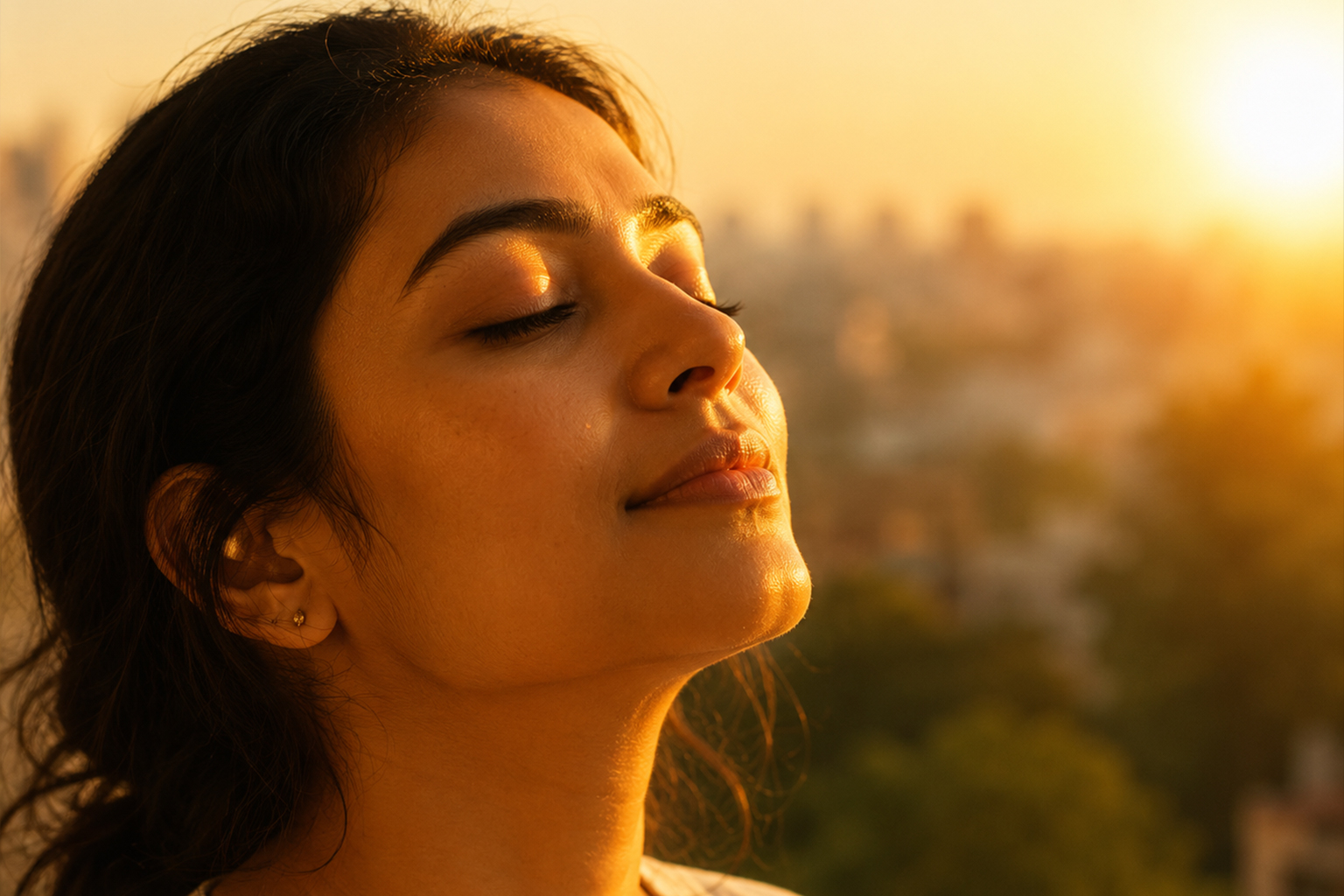
Delhi rooftop. 6:00 AM. The sky doing things I couldn’t explain. And a feeling — settled, clear, alive — that I couldn’t get enough of!
I’ve been a low-tox living and wellness coach for a while now. I help people detox their homes, their morning routines, their skincare, their cleaning products. And one of the biggest shifts I see? It’s not a swap you buy. It’s free. It rises every single morning.
It’s sunrise.
The Morning Light Myth You Need to Stop Believing Right Now
Here’s the thing nobody tells you.
Sunrise won’t give you Vitamin D.
Really?? Most people step outside and think, “great, I’m getting my vitamin D!” But UVB rays — the specific wavelength your skin needs to synthesise vitamin D — don’t actually reach the earth’s surface until the sun angle is high enough. In India, that means roughly 10 AM to 3 PM. Early morning and late afternoon sunlight blocks UVB entirely.
So what is happening at sunrise?
Something way more powerful.
What Sunrise Light Actually Does to Your Body
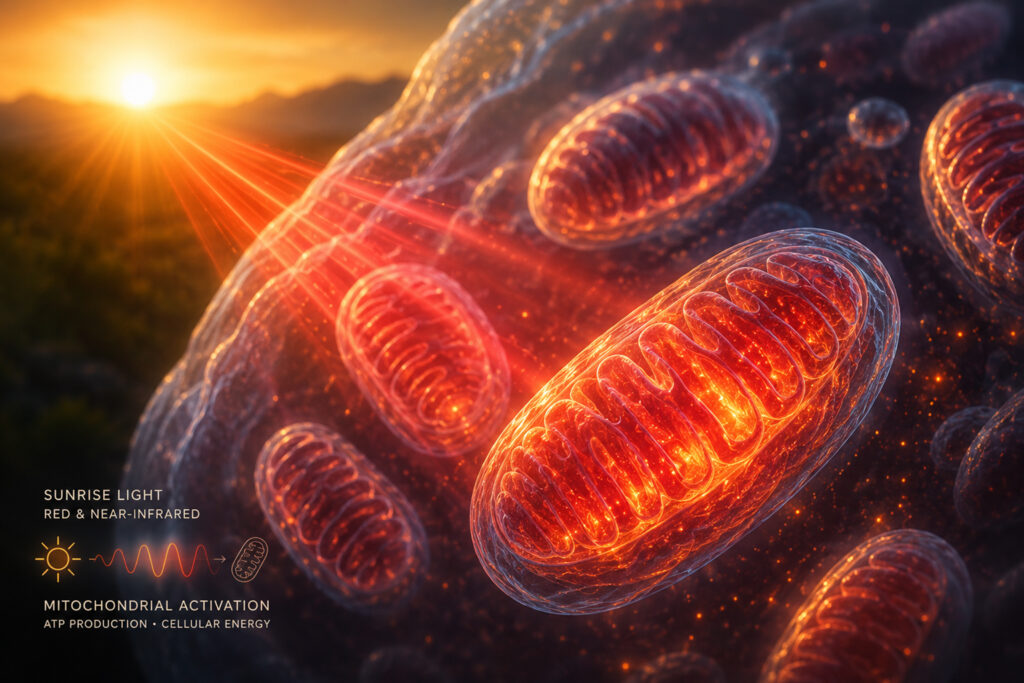
The light at dawn is rich in red and near-infrared wavelengths — and this is where you really feel the benefits!
These wavelengths penetrate your skin and interact with an enzyme in your mitochondria called cytochrome c oxidase. The result? A measurable increase in cellular ATP production — the fundamental energy currency of every single cell in your body. More ATP means more cellular energy. Better metabolism. Faster repair. Clearer thinking.
This process is called photobiomodulation. And it isn’t fringe science. A 2025 study published in scientific reports confirmed that near-infrared light from sunlight actually passes through the body — yes, through clothing, through tissue — and improves mitochondrial function systemically. Researchers from Glen Jeffery’s lab found that exposure to 670 nm red light produced a 27% reduction in blood glucose spikes after meals.
Your body is photosynthesising. In the most human way possible.
The Hormone Reset Hiding in Plain Sight
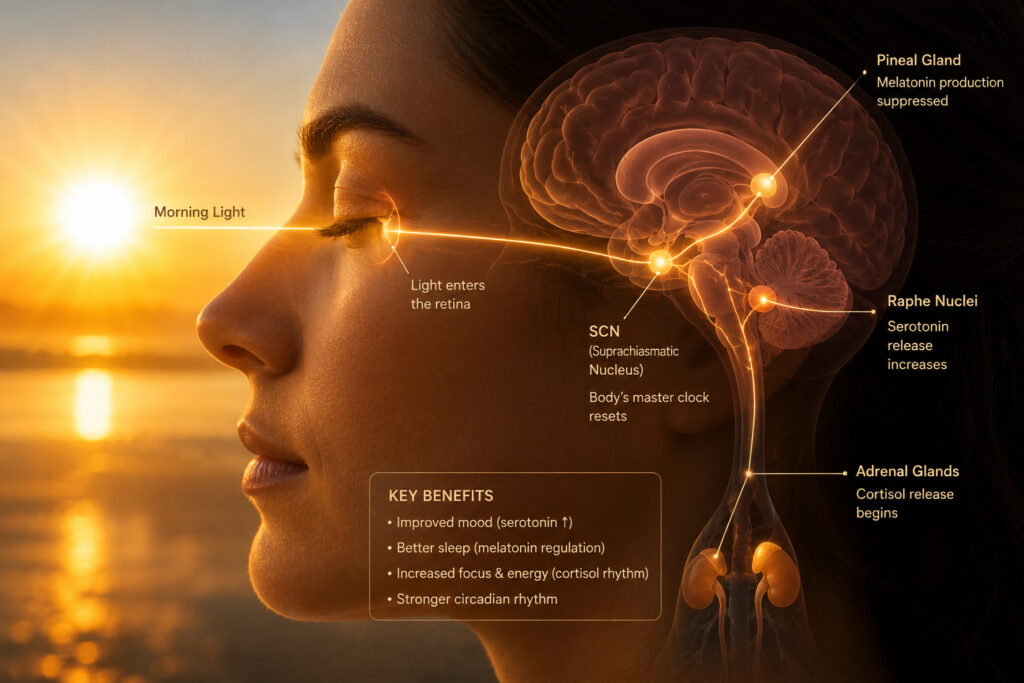
When morning sunlight hits your retina — even on a cloudy day — specialised light-sensitive cells called intrinsically photosensitive retinal ganglion cells (ipRGCs) send a direct signal to the brain’s master clock, the suprachiasmatic nucleus.
What happens next is a cascade
- Melatonin suppresses. Cortisol rises — healthily, cleanly, at exactly the right time. This is called the cortisol-awakening response. It’s not the stress response people fear. It’s the signal your body uses to wake up every organ system in sequence.
- Serotonin gets triggered. A landmark study in *The Lancet* found that serotonin production in the brain was directly proportional to the amount of bright sunlight available — rising rapidly with increased luminosity. More morning light. More serotonin. Consistently.
- Dopamine activates. Mood lifts. Motivation sharpens. Focus arrives — not from caffeine, but from the oldest signal on earth.
And sleep? A 2025 cross-sectional study of 1,762 adults published in BMC Public Health found that early morning sunlight exposure was associated with significantly improved sleep quality, faster sleep onset, and better circadian alignment. Research showing that natural morning light helped people fall asleep 22 minutes earlier at night.
The morning resets the night. Every single day.
Your Heart Is Listening Too
This one surprises people.
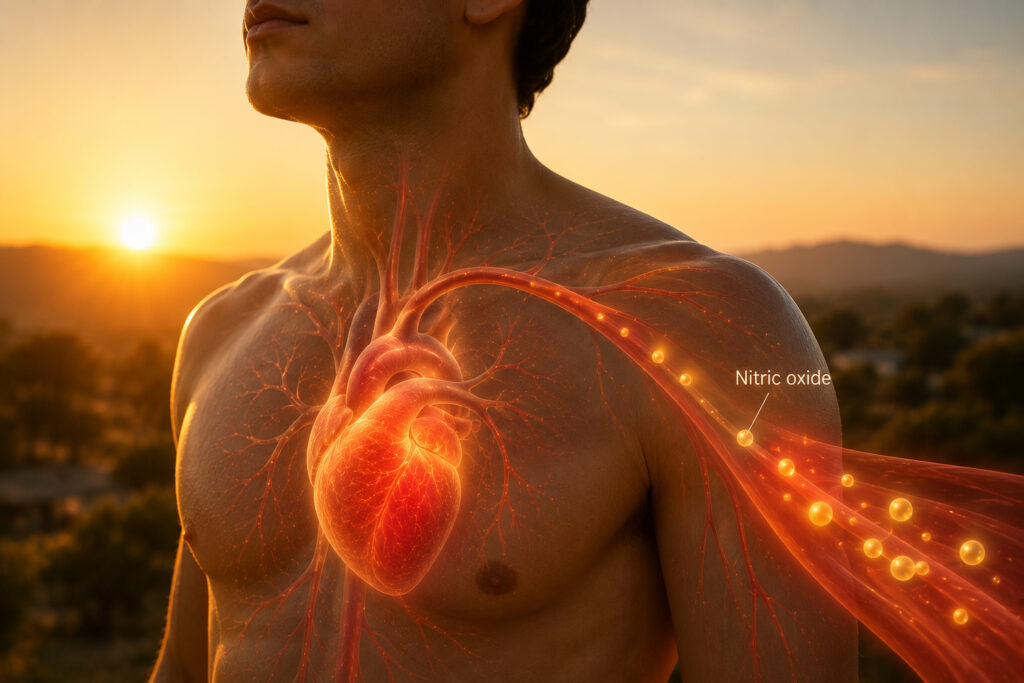
Even the UVA in early morning light — the gentle stuff that IS present at sunrise — triggers the release of nitric oxide in your skin. Nitric oxide dilates blood vessels. Lowers blood pressure. Improves circulation. A study by UK Health Security Agency confirmed the cardiovascular benefits of UV-triggered nitric oxide release — a real, measurable, natural mechanism for heart health.
No supplement stack required.
How to Make This a Non-Toxic Morning Ritual (Practical Steps)
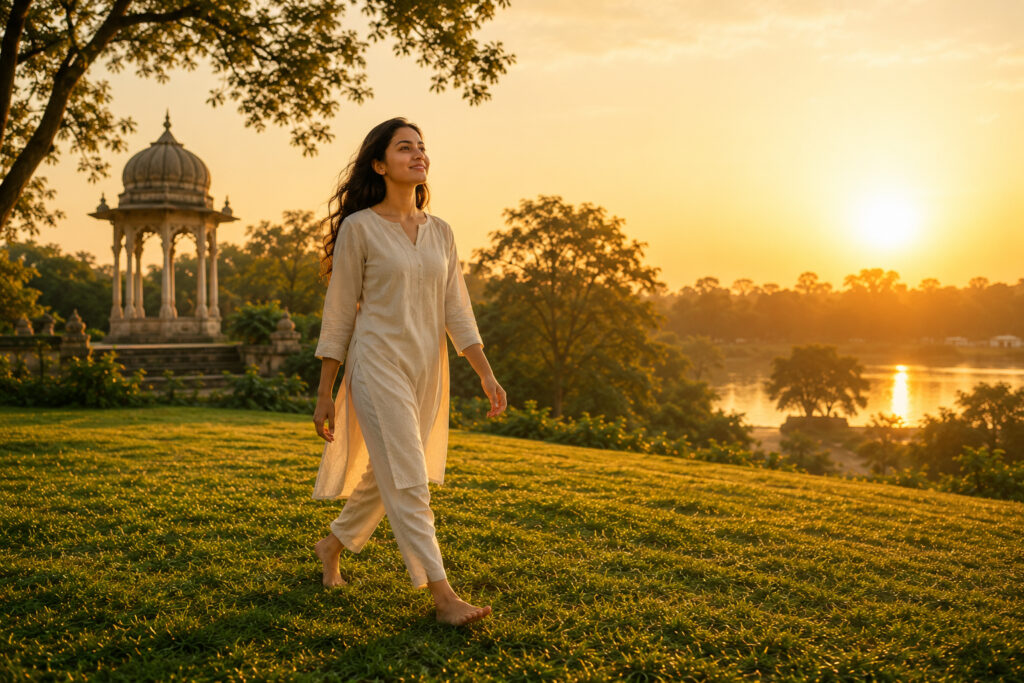
This is a habit. Not a performance.
You don’t need a perfect view. You don’t need to wake up at 4 AM. You don’t need to buy anything.
- Step outside within 30–60 minutes of waking. Even 5 to 10 minutes counts
- No sunglasses. The light needs to reach your retina, not be blocked by lenses
- No screen first. Let light — not blue light from your phone — be the first signal your brain receives
- Delay your caffeine 90 minutes. This lets your natural cortisol-awakening response do its job without interference
- Combine it with slow movement. A gentle walk, grounding barefoot on grass, or simple breathing outside — this amplifies the circadian signal
No fancy tools. No toxic products. No chemicals. Just you and the oldest free therapy on the planet.
A Note From My Coaching Practice
When I do home audits with clients, I ask one question early on: what does your morning look like?
Nine times out of ten, it starts with a phone. Alarm goes off. Screen on. Cortisol spiked wrongly. Circadian clock confused before the day even begins.
Swapping your toxic cleaning products matters. Switching your skincare matters. But restructuring your morning light exposure? That changes everything underneath.
It changes how your hormones fire. How your gut moves. How your brain focus lands. How deeply you sleep that night.
It’s the most non-toxic swap I know.
Citations
- Lambert GW, Reid C, Kaye DM, Jennings GL, Esler MD — “Effect of sunlight and season on serotonin turnover in the brain.” The Lancet, 360(9348):1840–2. Dec 7, 2002.
- Menezes-Júnior LAA, Sabião TS, Carraro JCC, Machado-Coelho GLL, Meireles AL — “The role of sunlight in sleep regulation: analysis of morning, evening and late exposure.” BMC Public Health, 25(1):3362. Oct 6, 2025.
- Jeffery G, Fosbury R, Barrett E, Hogg C, Rodriguez Carmona M, Powner MB — “Longer Wavelengths in Sunlight Pass Through the Human Body and Have a Systemic Impact Which Improves Vision.” Scientific Reports, July 8, 2025
- Alfredsson L, Armstrong BK, Butterfield DA, et al. — “Insufficient Sun Exposure Has Become a Real Public Health Problem.” International Journal of Environmental Research and Public Health, 17(14):5014. Jul 12, 2020.
- Bogh MKB, Schmedes AV, Philipsen PA, Thieden E, Wulf HC — “Vitamin D Production After UVB Exposure – A Comparison of Exposed Skin Regions.” Photodermatology, Photoimmunology & Photomedicine, 2014.
- Nair R, Maseeh A — “Vitamin D: The ‘sunshine’ vitamin.” Journal of Pharmacology & Pharmacotherapeutics. PMC: Air pollutants are negatively associated with Vitamin D-synthesizing UVB radiation, 2021.
- Mithal A, Dr. (Max Hospital Delhi) as cited in India Today — “As Delhi-NCR chokes on toxic air, doctors urge Vitamin D supplementation.” India Today, Nov 2, 2025