

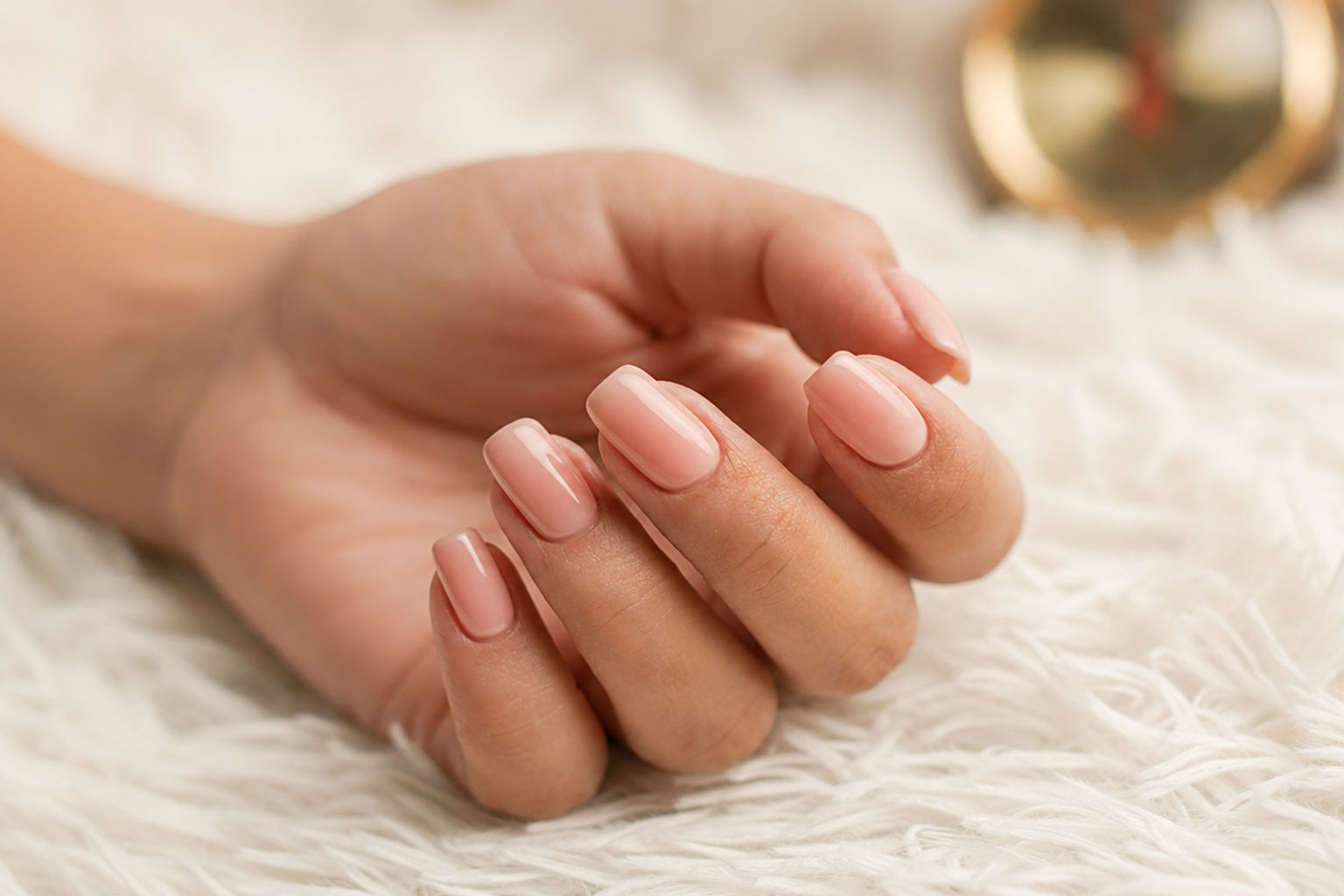
I was 22, waiting for my husband (then boyfriend) to propose, and I had absolutely no idea when it would happen or what the ring would look like. So I did what felt productive at the time — I got a manicure every single week. Looking back, I think it was less about the polish and more about wanting to feel ready for a moment I couldn’t control.
Years passed, and as I grew deeper into non-toxic living, nail polish quietly fell off my list. Not a dramatic decision — it just stopped making the cut as I swapped one product after another. My friends started noticing something else instead: “Your nails are so pink, ours are so yellow!” I never had a real answer beyond “I think it’s because I stopped using polish” — a guess, not a fact.
Lately, a lot of you have been asking me about nail polish, so I sat down and actually did the deep dive I’d never done for myself: the real research, the real chemicals, and why. What I found is this — nail polish isn’t automatically dangerous, and it isn’t automatically harmless either. This isn’t about fear, or about telling you to give up your manicure. It’s about knowing what’s actually in the bottle, so if you do want the occasional polish (like 22-year-old me, waiting on a ring), you know how to do it safely — and so does the person painting it on you for eight hours a day.
“Non-Toxic” On The Label Doesn’t Mean What You Think
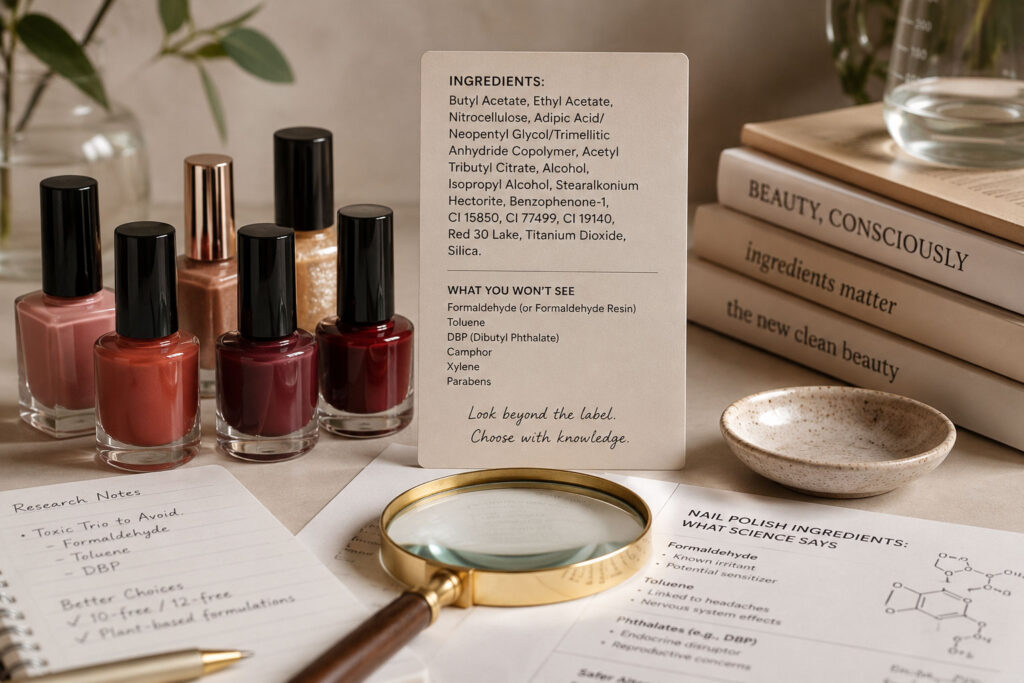
You’ve probably heard of the “toxic trio” — toluene, formaldehyde and DBP (dibutyl phthalate). Toluene is a solvent, formaldehyde sometimes shows up in hardeners, and DBP was traditionally used to stop polish going brittle. Repeated or high exposure to these can irritate your eyes, skin and airways, and some carry more serious hazard classifications with longer-term use.
Now, plenty of brands market themselves as 3-free, 5-free, 10-free or simply “non-toxic,” and that’s a decent starting point. But here’s what surprised me: a 2024 study tested 10 polishes that were all marketed as non-toxic — and found formaldehyde and toluene in every single one. Acrylic manicures came out worst for total chemical exposure in the air.
That doesn’t mean your manicure is doing you harm. It means “clean” on a label isn’t a guarantee — it’s marketing. Ventilation and how the product is used still matter just as much as what’s in the bottle.
The Ingredient Nobody Talks About: TPHP
There’s another one worth knowing — triphenyl phosphate, or TPHP. It’s used to keep polish flexible, and it’s drawn attention for its possible hormone-disrupting activity. I want to be honest here: research showing exposure is not the same as proof that your manicure causes hormonal problems. But it’s a good reminder that “free-from” claims can be inconsistent.
One study looked at 40 polishes across 12 brands and found “10-free” was defined six different ways depending on the brand — some products even contained plasticisers they claimed to exclude. The polishes labelled 5- to 13-free did tend to have lower TPHP levels than unlabeled or 3-free ones, so the claims aren’t meaningless — just not something to take at face value.
My rule of thumb: look for a brand that discloses its full ingredient list. If they won’t, that tells you something too.
Gel Nails Need Their Own Set of Rules
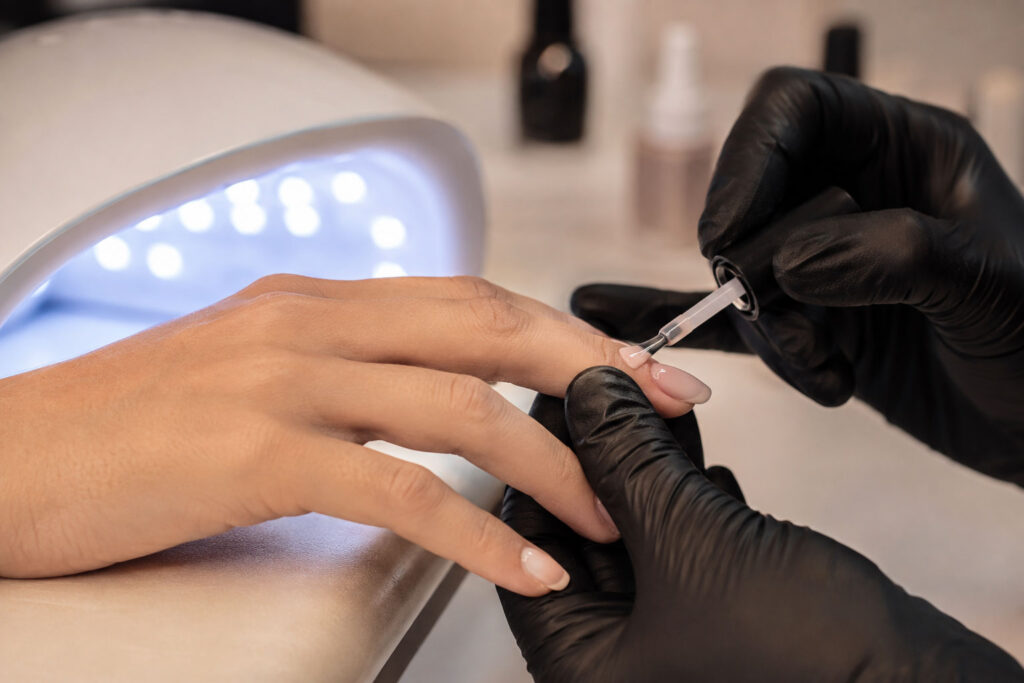
Gel manicures last, and that’s exactly why we love them. But gels often contain methacrylates, and when uncured gel sits on your skin — even briefly, even repeatedly — it can trigger allergic contact dermatitis in some people: itching, redness, swelling, peeling around the nail. The FDA specifically warns against letting these products touch your skin.
A few habits that make a real difference:
- Never cure gel polish that’s touched your skin
- Wipe away any spill before it goes under the lamp
- Don’t peel gel off — soak and lift it gently instead
- If your fingertips ever feel itchy, sore or inflamed after a gel manicure, stop and see a dermatologist
A 2025 review also flagged that as gel nails become more popular, allergic reactions to these ingredients are becoming more common too.
Spare A Thought for Your Nail Technician
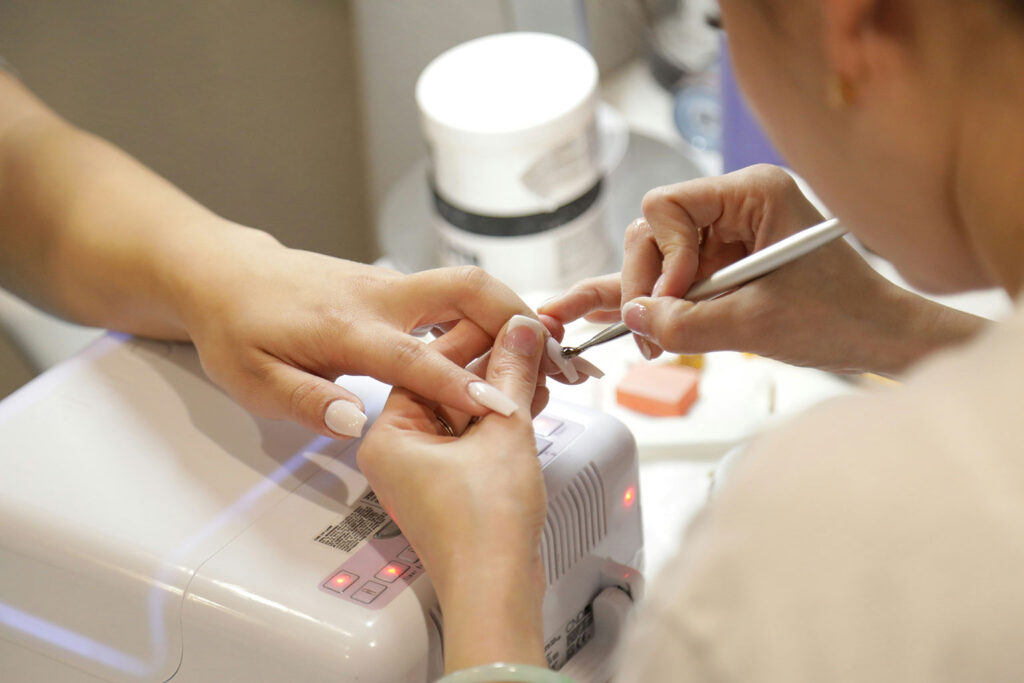
Your manicure takes half an hour. A nail technician may be doing this — polish, remover, gel, acrylic dust — eight hours a day, every working day. This is where it stops being a personal beauty choice and becomes a workplace health issue.
A 2024 pilot study on 37 nail technicians across 28 salons found measurable exposure to 42 different chemicals in their dust, hand-wipe and urine samples — significantly higher than a comparison group. Hand-to-mouth contact seemed to be a big part of it.
That’s not proof of illness. But it is a strong reminder that salon safety isn’t a luxury add-on — it’s basic protection for the people working there.
The good news: in that same 2024 research, simply adding local exhaust ventilation at the manicure table cut total chemical exposure by 30–70%. That’s a bigger difference than any “non-toxic” label could ever make. So next time you’re at the salon, notice the ventilation, the open windows, whether the workstation looks cared for. Choosing salons that take this seriously is one small way to vote with your rupees.
My Lower-Toxicity Nail Routine
I’m not telling you to give up polish. You can still enjoy a good manicure before a big event!
This is just how to make it gentler:
- Choose brands that share their full ingredient list, not just a “free-from” badge
- Save polish for when you’ll genuinely enjoy it, rather than a weekly default
- Apply thin coats, windows open, fan on if you have one
- Keep uncured gel off your skin, always
- Go easy on the acetone — it’s drying and irritating with overuse
- Give your nails regular polish-free breaks
Use less. Ventilate more. Read past the label. Same manicure — a much lighter chemical load.
I still think about 22-year-old me, getting a weekly manicure I didn’t even really need — and I don’t judge her for it. If you’re somewhere on that same journey, still figuring out which products are worth keeping and which ones can quietly go, that’s exactly the kind of thing I help my coaching clients work through, one swap at a time. Get in touch and let’s figure out your first step together.
Sources
- Anderson K. et al., Evaluation of Chemical Exposures and Exposure Mitigation Strategies for Nail Salons (2024)—simulated manicure testing and local exhaust ventilation findings. oup
- Song X. et al., Occupational Exposure of Nail Technicians to Industrial Chemicals: A Pilot Study (2024)—biomonitoring study of 37 nail technicians in 28 salons. ncbi.nlm.nih
- de Paula AC. et al., Nail Polishes: A Review on Composition, Presence of Toxic Components, and Inadequate Labeling (2025). ncbi.nlm.nih
- Allen JG. et al., Phthalate and Organophosphate Plasticizers in Nail Polish: Evaluation of Labels and Ingredients (2018), archived by NIOSH. cdc
- S. Food and Drug Administration, Nail Care Products—consumer guidance on formaldehyde and methacrylate-related allergy. fda