

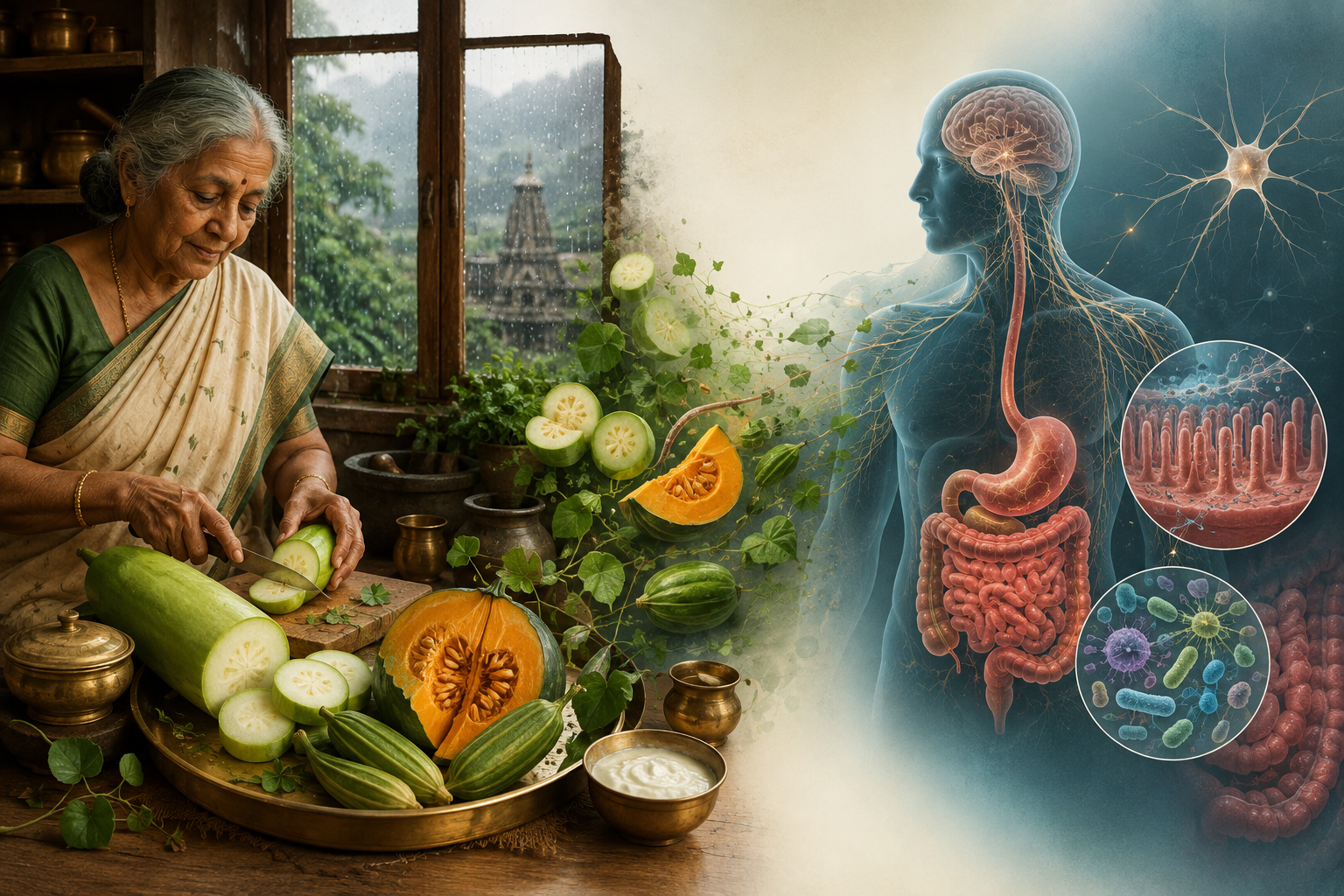
I used to roll my eyes at Sawan rules.
No saag. No brinjal. Fast on Mondays. Chant at sunrise. Sounded like blind ritual to me.
Then I actually researched it.
Turns out my grandmother wasn’t being dramatic. She was running a seasonal biology protocol — thousands of years before “gut health” became a hashtag.
Why Monsoon Weakens Digestion (And Why Sawan Food Rules Exist)
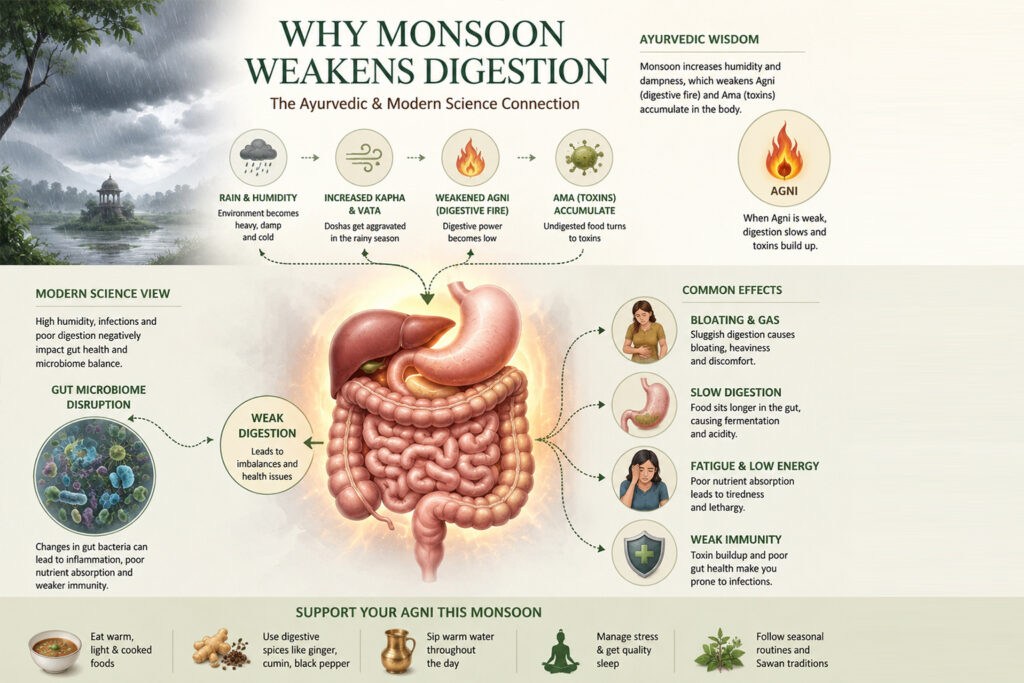
Here’s what nobody tells you about the rains.
Humidity spikes. Your Agni — digestive fire, in Ayurvedic terms — weakens. Vata rises. Bloating shows up. So does fatigue. So does that weird low-energy fog you can’t explain.
Ancient texts didn’t guess this. They built an entire seasonal system around it.
Why Your Ancestors Banned Saag in Sawan
“Sawan mein saag nahi.” No greens in Sawan.
I always thought this was a religious quirk. It’s widely believed to be rooted in food safety — humid soil is reported to breed more bacteria, and wet leaves can trap contaminants that survive a quick rinse. Your saag isn’t just saag in monsoon — it’s a risk you don’t need to take.
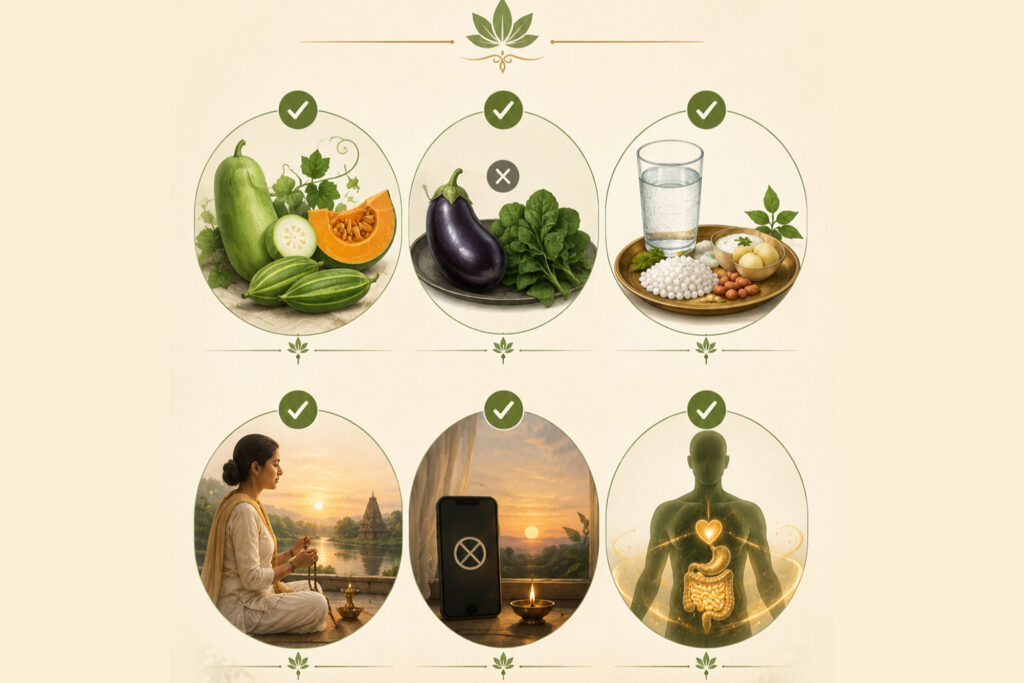
The swap: bottle gourd (lauki), pumpkin, pointed gourd (parval).
Brinjal Is the Monsoon’s Biggest Offender
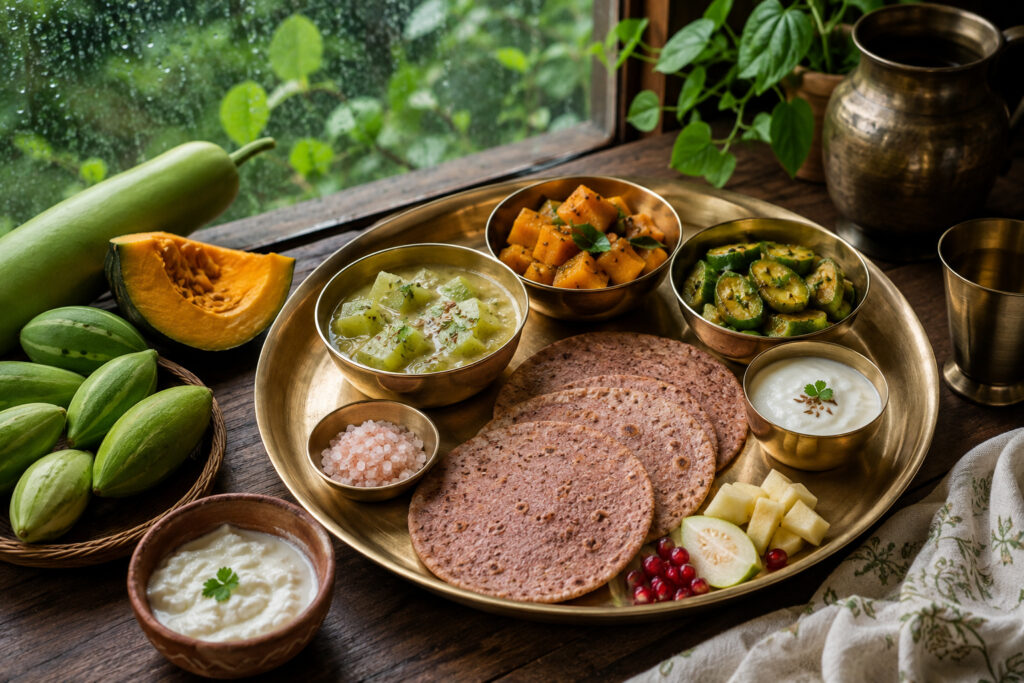
Brinjal grows touching wet soil. That makes it a magnet for insects and bacterial contamination during rainy months. Lauki and pumpkin also grow close to the ground, but brinjal attracts more pests on the fruit itself and its smooth skin traps more moisture, making it riskier in humid monsoon if it isn’t washed, checked for damage, and cooked well.
From an Ayurvedic lens, brinjal is considered heating and vata‑aggravating, so in the damp monsoon—when digestion is more delicate—it can more easily trigger gas, bloating and minor skin flare‑ups compared to lauki or pumpkin!
The Charak Samhita — an ancient Ayurvedic text — flagged this eons before anyone had a microscope. Skip it this month. Your gut will thank you.
The Weekly Sawan Somwar fast
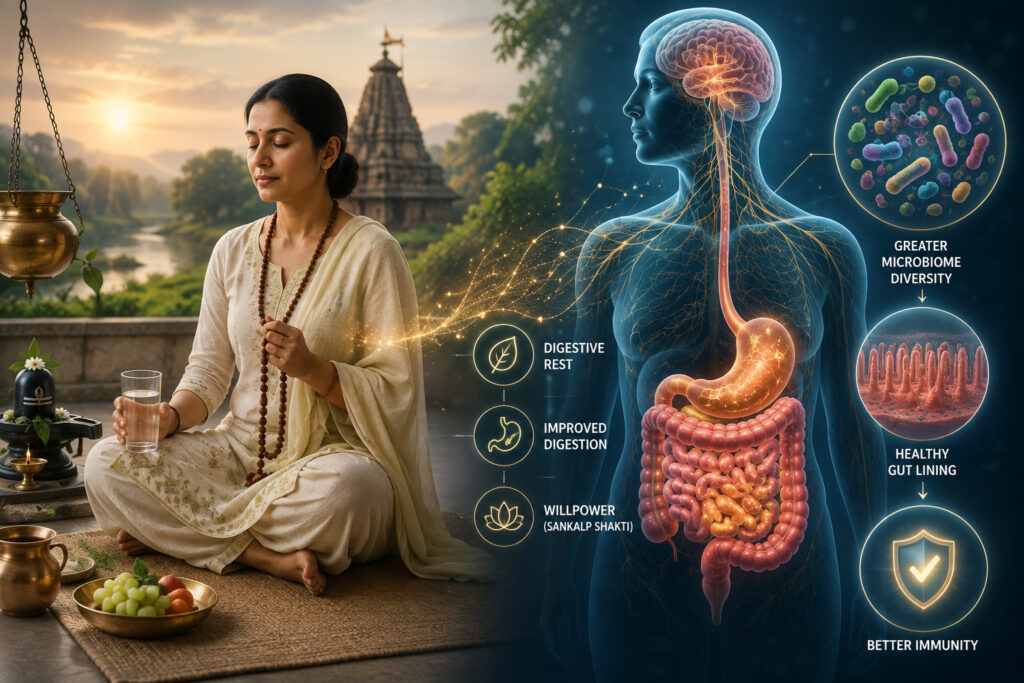
“Somwar” comes from Soma, the moon. Shiva wears it. He’s worshipped as Someshwara on this day.
But here’s the real hook: a weekly fast is scheduled intermittent fasting. A 2024 clinical trial published in Nature Communications found that intermittent fasting improved gut symptoms and increased beneficial microbial diversity compared to standard calorie restriction. A separate 2024 systematic review in Frontiers in Nutrition concluded that intermittent fasting improves gut microbial richness and diversity.
That’s not mysticism. That’s habit science with a spiritual wrapper.
Devotees also talk about sankalp shakti — willpower built one Monday at a time.
Chanting Isn’t Just Devotion — It’s Nervous System Regulation
Chant “Om Namah Shivaya.” 108 times, ideally, on a mala.
Here’s the part that surprised me most. A 2022 study published in the International Journal of Yoga found that just 5 minutes of OM chanting enhanced parasympathetic nervous system activity and promoted measurable relaxation via heart rate variability. That’s your vagus nerve — the same one wellness circles obsess over now — being calmed by a practice that’s thousands of years old.
Try this at home:
- 5-10 minutes of chanting at sunrise
- One digital-free hour at dusk
- Sit facing east — a small cue that tells your brain: reset time
Your Sawan Reset Checklist
- Swap greens for gourd and pumpkin
- Skip brinjal this month
- One Monday light fast
- Chant at sunrise, even for 5 minutes
- One digital-free hour at dusk
Save this list. Screenshot it. Put it on your fridge.
We call it restriction. It’s really an instruction manual — for your gut, your nervous system, and your willpower, disguised as ritual before we had the language for biology.
Our grandmothers weren’t superstitious.
They were just ahead of the science.
References
- Inbaraj G, et al. Immediate Effects of OM Chanting on Heart Rate Variability Measures Compared Between Experienced and Inexperienced Yoga Practitioners. International Journal of Yoga. 2022[pmc.ncbi.nlm.nih]
- Mohr AE, et al. Gut microbiome remodeling and metabolomic profile improves in response to protein pacing with intermittent fasting versus continuous caloric restriction. Nature Communications. 2024[nature]
- Paukkonen I, et al. The impact of intermittent fasting on gut microbiota. Frontiers in Nutrition. 2024[pmc.ncbi.nlm.nih]