
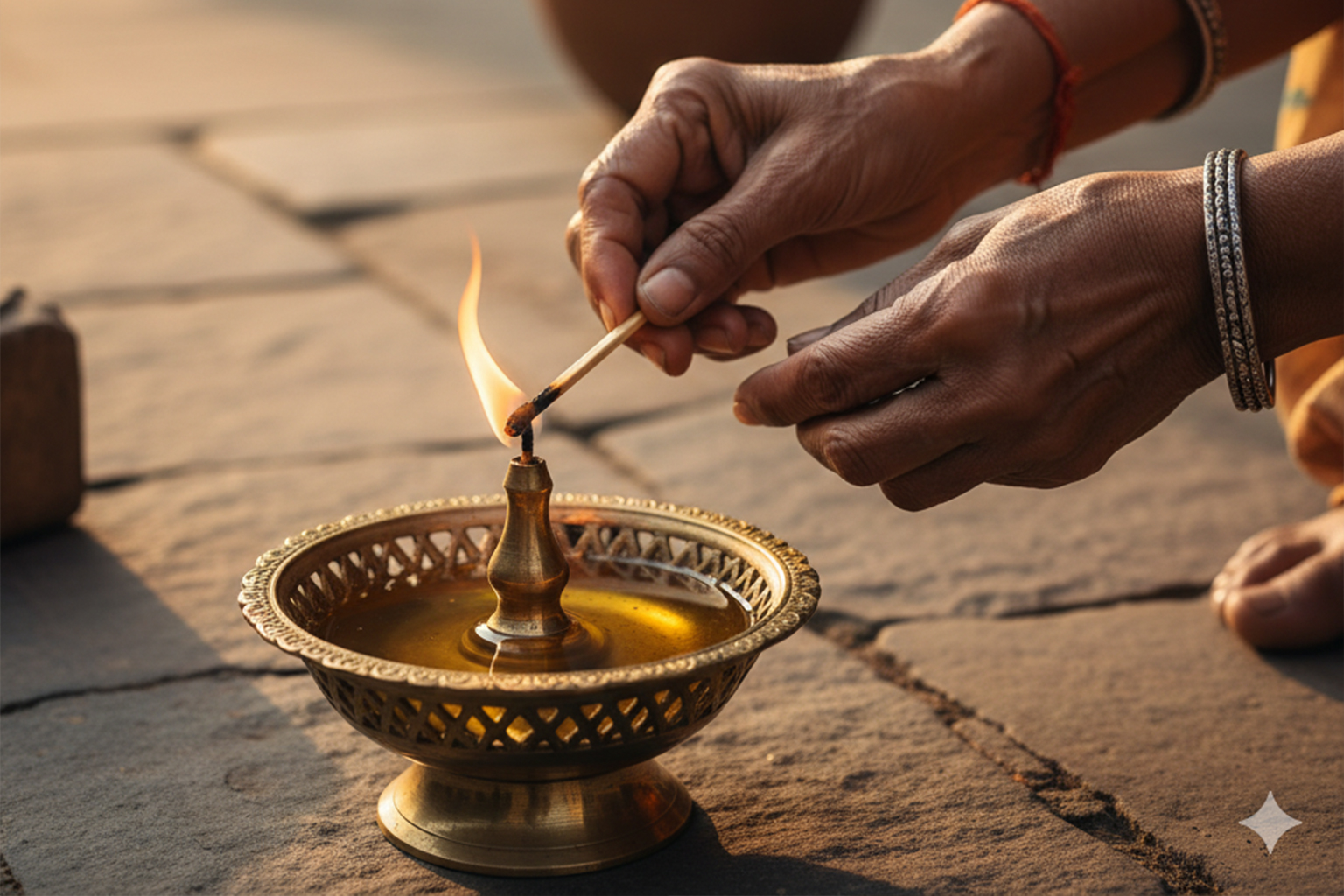
Our ancestors lit a diya every single evening.
Small clay lamp. Ghee. Cotton wick. Never missed a day.
I used to think it was just religious ritual. Something old people do, not relevant with today’s automatic lights.
Then I started doing Tratak in yoga and read the research on fire meditation.
Turns out, they knew something modern neuroscience is only now confirming.
What We Lost When We Stopped Lighting Real Flames
For thousands of years, humans gathered around fire daily. Cooked with it. Told stories. Marked time.
Then electricity happened. Flip switch, get light. No ritual. No pause.
We replaced real flames with LED bulbs and synthetic scented candles (which, as I covered in my article on toxic candle alternatives, are literally poisoning our homes).
But we lost the act of mindfully lighting and watching a real flame.
The evening diya wasn’t about light—there was electricity. It was about the pause. The moment marking transition from day to night.
Modern neuroscience calls this a “behavioral anchor.” Our ancestors just called it evening prayer.
The Science Behind Fire Gazing
A 2014 study found that watching fire lowers blood pressure and promotes relaxation. The flicker pattern operates at a frequency that naturally calms the nervous system.
Your nervous system literally relaxes when watching real flames.
It’s why people zone out at campfires. Why fireplace videos get millions of views.
We’re hardwired to find fire calming. Thousands of years of evolution cannot disappear in two generations.
Traditional Fire Rituals Across The World
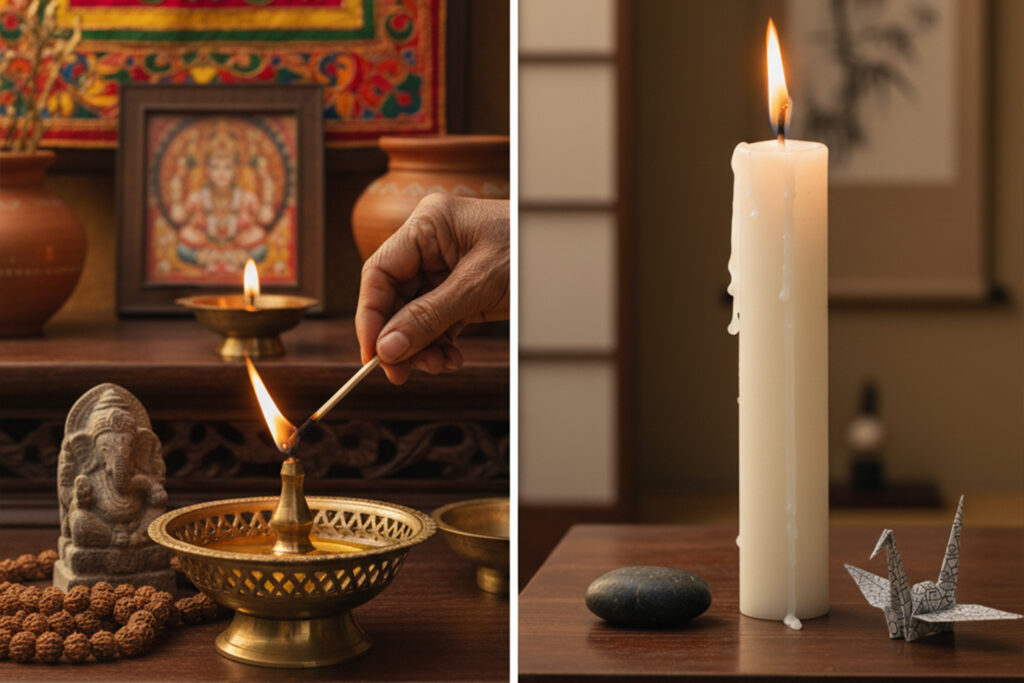
Indian Evening Diya Practice
- Sandhya means transition time—dawn and dusk. Lighting a lamp at sunset marks the shift from action to rest.
- The act itself creates presence. You can’t scroll while properly lighting a wick.
- Five seconds of forced presence in a world that never stops.
Japanese Candle Meditation
- Not just India. Japan has similar practices using traditional wa-rousoku (Japanese candles made from plant wax).
- Zen monasteries use candle meditation as preparation for deeper practices.
- The principle is the same—focused attention on flame as anchor for presence.
Tratak: The Fire Meditation I Am Addicted To
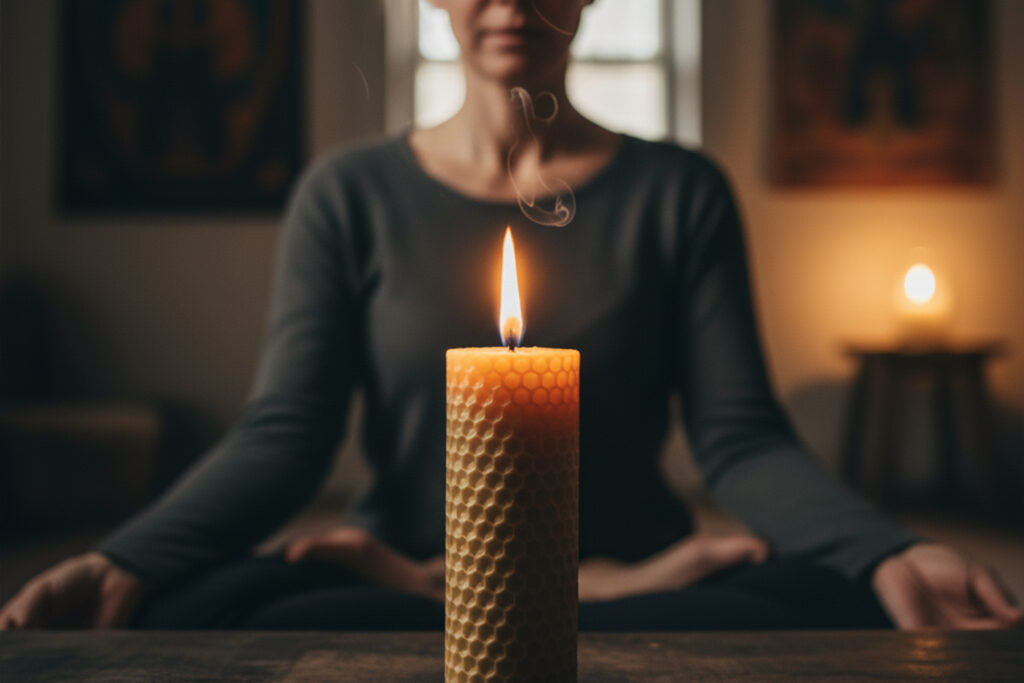
- Tratak is yogic focused gazing—usually at a candle flame.
- I studied it, skeptical, but wanted to try it!
- When I finally did try it, my mind went completely silent for the first time in years.
What Tratak Does
Eyes water (cleaning tear ducts), mind stops racing, thoughts slow dramatically. With regular practice: improved concentration, better eyesight, reduced anxiety.
It forces single-pointed focus. Like a gym workout for your attention span.
A 2016 study found tratak significantly improved cognitive function and attention span. Another showed improved visual perception with 30 days practice.
How to Do Tratak
- Use pure beeswax candle or a ghee lamp (never paraffin). Sit 2-3 feet away at eye level in a dim room, best at or after sunset.
- Stare without blinking as long as you can. When eyes water heavily, close them and visualize the afterimage. When it fades, repeat. Do 10-15 minutes total.
- Start with 5 minutes. Eyes will water like crazy—that’s normal.
- I do tratak 3x-4x per week. My sleep is better those days, I feel my eye muscles have strengthened.
What the Elders Knew
My grandmother just lit her evening lamp like her mother taught her. Never missed a day for 60+ years.
She used ghee because it burns clean and creates calm energy. Her neighbor used sesame oil for grounding winter warmth. Another aunt used mustard oil to dispel negative energy.
They didn’t randomly pick oils. Each had purpose.
- That consistency—the rhythm, the pause, the intention—probably did more for her mental health than she realized.
- She didn’t need research papers. We do, apparently. We need studies before trying what our ancestors did daily.
- But now we have that evidence. And it confirms what traditional practices always knew: mindfully engaging with real fire calms the nervous system, improves focus, creates sacred pause.
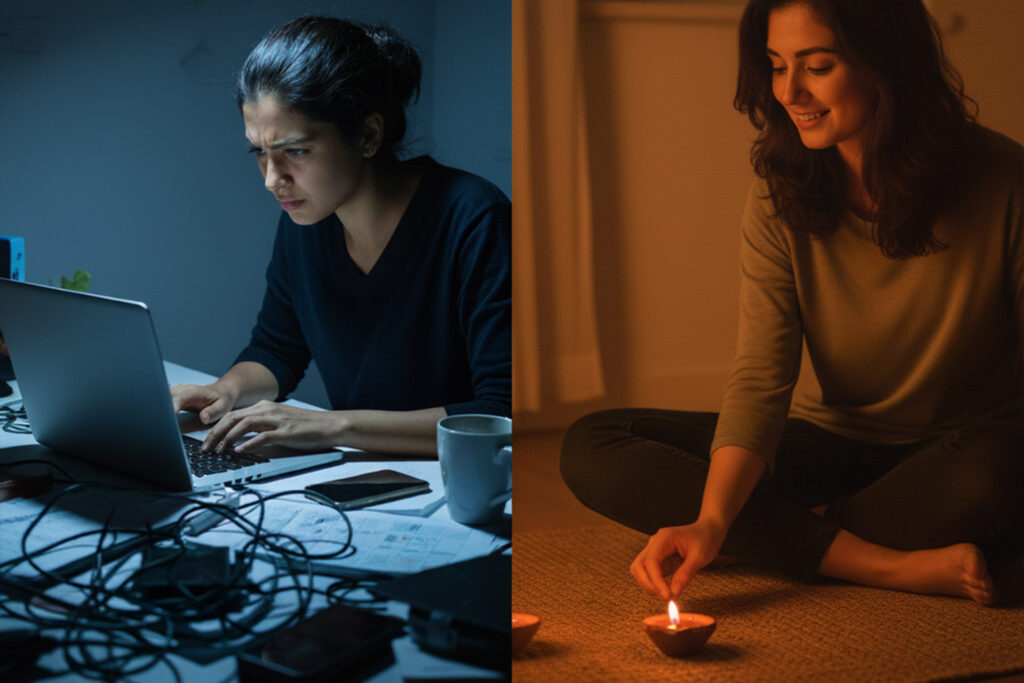
The Bottom Line
- You don’t need to become a fire-worshipping yogi.
- Just try lighting one real flame mindfully this week.
- Not a toxic synthetic candle you’re ignoring. (Read my other article about why those poison you.)
- A real flame. Beeswax or ghee diya. Lit with intention.
- Sit with it for two minutes. Just watch.
Your nervous system might remember something your mind forgot.
We’re built for fire.
Small change, big impact.
What will you implement after reading this? Take 2 minutes to write it down – our brains forget 90% of what we read within 24 hours unless we actively engage with it. Email yourself a reminder and cc me at [email protected] to start a conversation!
Research Sources & Citations
- Lynn, C. D. (2014). “Hearth and campfire influences on arterial blood pressure.” Evolutionary Psychology, 12(5), 983-1003.
- Joshi, S., et al. (2016). “Effect of trataka on cognitive functions in the elderly.” International Journal of Yoga, 9(1), 23-28.
- Pandya, P. (2018). “Immediate effect of Trataka on cognitive performance.” International Journal of Research and Analytical Reviews, 5(4), 543-548.